

Guide to Investing in Physical Gold in Uruguay
At a time when markets are changing rapidly and economic uncertainty is becoming part of the daily landscape, gold is reclaiming its historical place: that of a silent, tangible, and timeless refuge.
Investing in physical gold is not a fad. It is a patrimonial decision. A way to preserve value in an asset that does not depend on digital promises or financial institutions, but on something much simpler and older: its very existence.
In Uruguay, more and more people are approaching this type of investment with a clear question: how to start, where to buy, and what to consider.
Gold as a store of value
For centuries, gold has been one of humanity's most consistent stores of value. Its scarcity, durability, and global acceptance make it a unique asset within the investment universe.
Unlike other financial instruments, physical gold does not represent a future promise: it is direct possession. It can be stored, transferred, or sold at any time, maintaining its international recognition.
In contexts of inflation or volatility, its role becomes even more relevant: it functions as a form of wealth protection, not necessarily as a vehicle for aggressive profitability.
Physical gold vs. financial gold
Before investing, it is crucial to understand that there are different ways to gain exposure to gold.
Financial gold (such as ETFs or funds) allows investment without physical possession of the metal. It is more liquid and accessible, but depends on intermediaries.
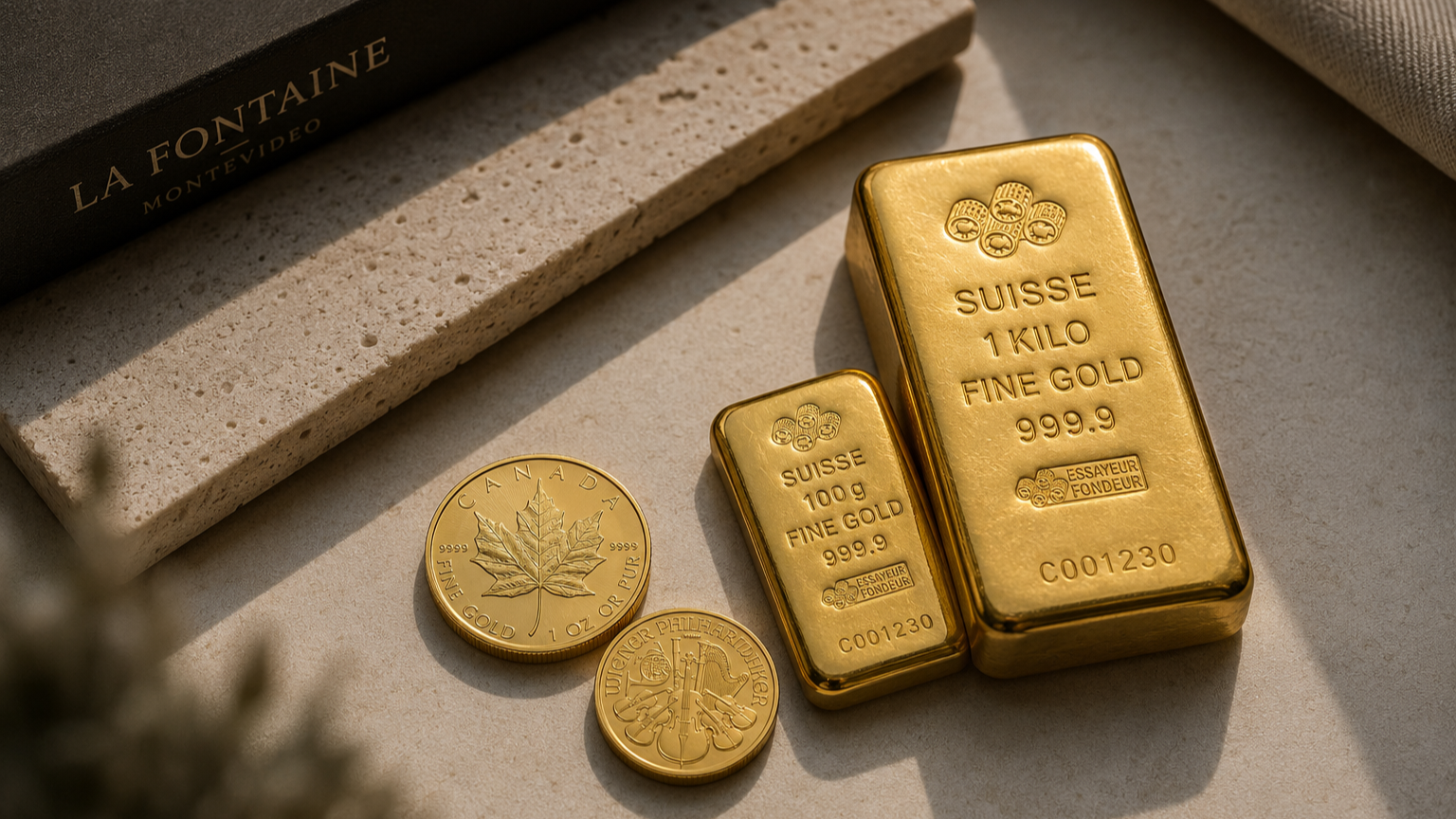
Physical gold, on the other hand, involves acquiring the real asset: coins or bars. This introduces a different dimension to investment, where the tangibility and direct control of the asset are central.
There is no universal correct option. Everything depends on the investor's profile, time horizon, and risk tolerance.
Physical gold investment formats
In the Uruguayan market, physical gold is usually presented in two main formats:
- Investment coins
- Bars of various weights
The choice depends on the strategy. Bars are usually more efficient for direct investment, while coins can offer greater flexibility when selling.
In all cases, the purity of the gold and its international quotation are the factors that determine its value.
How the price of gold is determined
The price of gold is neither arbitrary nor local. It is governed by the international market quotation, which fluctuates daily.
In Uruguay, the final purchase price usually reflects:
- International gold price
- Purity of the metal
- Weight of the piece
- Intermediary's margin or commission
This means that gold is a highly transparent asset in its valuation, although its final price may vary depending on the point of purchase.
What to consider before investing
Investing in physical gold involves more than just buying the metal. It also requires considering practical aspects:
- Custody: where and how it will be stored
- Liquidity: ease of sale depending on the chosen format
- Time horizon: gold is usually considered a long-term investment
Gold does not seek speed. Its logic is that of time.
An asset for thinking about wealth, not impulse
The most common mistake when approaching gold is expecting it to be a quick-return investment. Its nature is different.
Physical gold is best integrated into a wealth diversification strategy, where it plays the role of a stabilizer, not an accelerator.
It is a decision that usually grows in value over time, but above all with the right intention.
In Uruguay: access and support
Today, it is possible to access the physical gold market in Uruguay through specialized houses that work with investment coins and bars, providing advice on formats, availability, and quotation.
In this context, at La Fontaine, we work with investments in physical gold, specifically in coins and bars, supporting those who seek to incorporate this type of asset into their wealth strategy, with clear information, transparency, and discernment.
Conclusion
Investing in physical gold is, in essence, a way to return to the tangible in an increasingly abstract world.
It is not a quick or speculative bet. It is a silent construction of value over time.
And like any patrimonial decision, it begins with clear information, discernment, and perspective.
